
Hormonal birth control alters mood-regulating hormones, and research links these changes to shifts in attraction and emotional bonding. Some women report feeling less connected to partners while on the pill. Her Smart Choice provides personalized gynecological consultations to help women understand these effects and explore alternative contraceptive options.
Get SOCIAL with us!
Hormonal birth control can influence emotional bonding, and research points to oxytocin as one reason. A study from Aarhus University found that women who take birth control pills carry much higher levels of oxytocin, the hormone also called the love hormone, in their blood than non-users. That finding, published in Scientific Reports, helps explain why hormonal contraception affects emotional life.
Oxytocin is a hormone the body produces naturally. It is secreted during social cues and bonding, and it reinforces social behavior. Associate Professor Michael Winterdahl of Aarhus University notes that a constantly elevated level of oxytocin may mean the hormone is not secreted in the same dynamic way as under normal conditions. A steady high level can therefore disrupt normal emotional responses, which may dull feelings toward a partner.
Attachment depends on hormonal rhythms, not a single fixed switch. When oxytocin stays elevated rather than rising and falling with social cues, the bonding signal loses some of its contrast. Some women notice a shift in how they feel toward a partner. Others notice nothing at all, because individual responses vary.
Tracking mood, attraction, and intimacy alongside a contraception start date gives a clinician useful information. Her Smart Choice provides birth control services and personalized consultations to help women understand how contraception affects their health. A licensed OB/GYN can review the method in use and discuss alternatives. Same-day appointments are available by calling 213-344-0267.
Hormonal birth control can influence attraction, but the effect is subtle and varies between individuals. Research on this question focuses on hormonal methods specifically, including the pill, the patch, and the hormonal IUD. Non-hormonal methods fall outside that body of research.
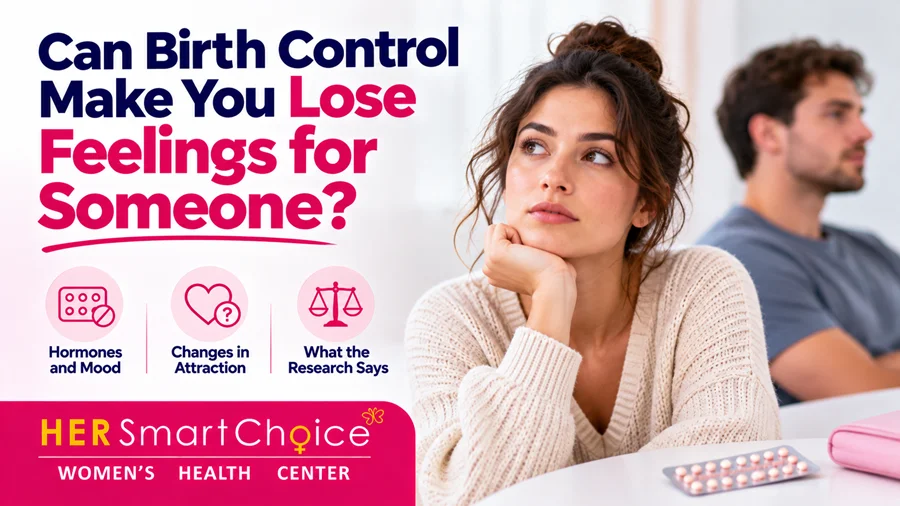
Can birth control make you lose feelings for someone is a question many patients raise when intimacy shifts after starting a new method. The honest answer is that feelings rarely vanish outright. More often, a side effect is being misread as a change of heart.
Low libido and mood changes from contraception are sometimes mistaken for a change in attraction to a partner. A patient may notice less desire for closeness and conclude the relationship itself has changed. The contraceptive, not the relationship, may be driving the shift. Separating the two takes more than intuition.
A hormone evaluation is the most reliable way to sort out what is actually happening. Guesswork and switching methods blindly both leave the real cause unaddressed. A clinical assessment gives patients a factual starting point instead.
Her Smart Choice provides gynecological services and private consultations with licensed Ob/GYNs for patients weighing these concerns. The clinic has served Los Angeles since 2006 and offers same-day appointments at 213-344-0267.
Research confirms that hormonal birth control alters emotional processing and bonding mechanisms. Studies link these contraceptives to measurable changes in oxytocin levels and mood regulation, which directly impact romantic relationships. Without understanding these biological shifts, women risk misattributing emotional distance to relationship failure rather than a medication side effect.
Aarhus University researchers discovered that women taking birth control pills have significantly higher blood levels of oxytocin compared to non-users. Associate Professor Michael Winterdahl of the Department of Clinical Medicine explains that oxytocin is secreted during social cues and bonding, reinforcing social behavior. Elevated oxytocin from the pill disrupts this natural signaling system. The hormone's normal function in partner attachment becomes dysregulated, potentially dulling the emotional rewards of intimacy.
The pill's hormonal disruption extends beyond mood into partner perception. Scientific research indicates that taking hormonal contraceptives can wreak havoc on a person's love life. The biological mechanisms that govern attraction and emotional connection shift under synthetic hormones. These changes often go unrecognized until relationship dissatisfaction becomes severe.
Mood alterations rank among the documented side effects of birth control pills. These alterations influence emotional life by flattening the natural hormonal fluctuations that drive desire and bonding. A woman may experience reduced emotional responsiveness to her partner without understanding the pharmaceutical origin. Her Smart Choice has helped thousands of women through personalized treatment plans addressing these reproductive health concerns. The clinic's experience underscores how common yet overlooked this connection remains.
Hormonal birth control changes the body's hormone balance, and those shifts can influence mood and emotional experience. Some users describe a flattening of feelings, often called emotional blunting, during the adjustment phase after starting or switching a method. The effect is not universal, and research on it remains limited. Still, the connection between hormonal change and emotional state is well documented in clinical settings.
Hormonal contraception works by altering the body's natural hormone levels. Those same hormonal shifts that trigger common side effects, such as breakthrough bleeding, can also affect mood and emotions. Spotting on birth control is a frequent response to hormonal change, and emotional fluctuations follow a similar pattern for many users. Recognizing this link helps separate a medication effect from a genuine change in a relationship.
Most people move through an adjustment phase in the first months after starting or switching methods. Emotional changes, including reduced libido or mood shifts, often appear during this window. Knowing typical timelines and common causes eases anxiety and helps keep contraception effective. Symptoms that persist well beyond the expected adjustment period warrant a clinical conversation.
Supportive, non-promotional guidance and care navigation help individuals decide whether a clinical evaluation is needed. Her Smart Choice provides that kind of resource for people weighing emotional or physical side effects. A provider can review the method, the timeline, and the person's history before recommending any change.
A physical cause sometimes underlies emotional distance. A displaced Mirena IUD can trigger pain or unusual bleeding. Those symptoms often disrupt intimacy and strain a partner bond. Her Smart Choice notes that a Mirena IUD out of position may reduce contraceptive effectiveness and create physical discomfort that interferes with closeness.
A private consultation with a licensed Ob/Gyn helps separate physical side effects from relationship concerns. The clinician reviews the IUD’s placement and discusses whether the current method still fits the patient’s emotional and physical needs. That conversation opens a path to alternative contraception if the present option proves unsuitable.
Convenient access reduces delays that let worry grow. Her Smart Choice operates locations in East LA, Huntington Park, Long Beach, and Van Nuys. The company serves patients throughout the greater Los Angeles area, Orange County, and Ventura County. Same-day appointments make it practical to address can birth control make you lose feelings for someone concerns before they deepen.
Oxytocin stays elevated rather than rising and falling with social cues, which disrupts the bonding signal. Some women notice a shift in feelings, while others notice nothing.
Track mood, attraction, and intimacy alongside the contraception start date, then consult a licensed OB/GYN. Her Smart Choice provides personalized consultations and same-day appointments by calling 213-344-0267.
Low libido and mood changes are sometimes mistaken for a genuine change in attraction to a partner. A hormone evaluation provides the most reliable way to determine the cause.
If emotional distance appears after starting or switching birth control, treat it as a question worth investigating rather than a verdict on the relationship. Track when symptoms began relative to the method start, separate libido and mood changes from a shift in attraction, and request a hormone evaluation instead of switching methods blindly. A private consultation with a licensed OB/GYN clarifies whether a physical side effect or a genuine relationship concern drives the change, and that conversation opens the path to a method that fits both emotional and physical needs.
Get SOCIAL with us!



East LA: 2226 E Cesar E Chavez Ave, Los Angeles, CA 90033, United States
Van Nuys: 7220 Woodman Ave #106, Van Nuys, CA 91405, United States
Long Beach: 1760 Termino Ave #223, Long Beach, CA 90804, United States
Huntington Park: 7024 Seville Ave Suite A, Huntington Park, CA 90255, United States
©2006 – 2026 HER SmartChoice, DBA Cathedral Medical Inc. | Sitemap | Terms & Conditions | Privacy Policy