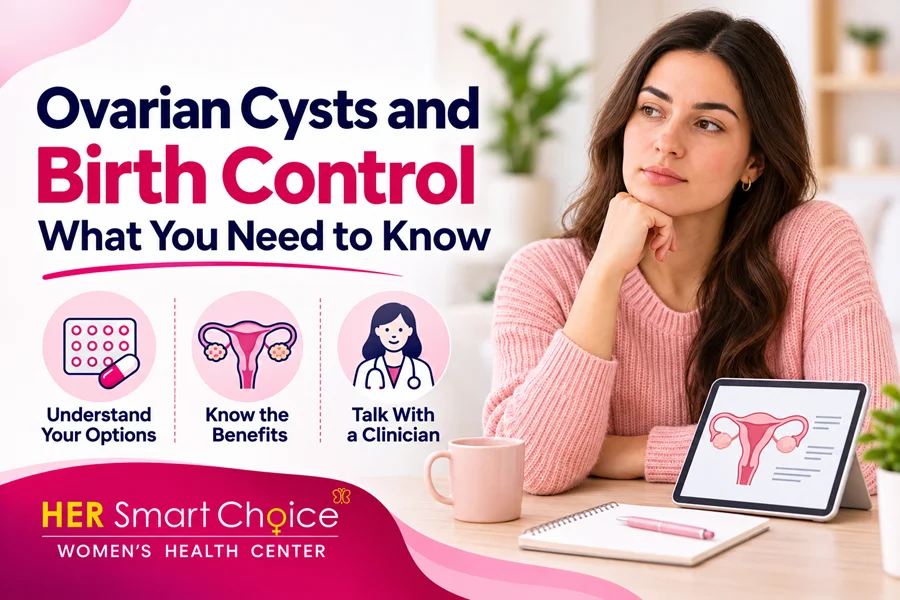

Most ovarian cysts are functional cysts that form as a normal part of the menstrual cycle, and most go away on their own within a few menstrual cycles. Birth control pills stop ovulation, which may lower the chance of new functional cysts forming, so providers sometimes suggest them for people who keep getting cysts. Pills don't shrink a cyst you already have, though. A Cochrane review of randomized trials found that combined birth control pills did not make functional cysts go away faster. They also don't affect cysts that aren't tied to ovulation, like dermoid cysts or endometriomas. Her Smart Choice provides gynecological care and birth control counseling to help you sort out which situation applies to you.
Get SOCIAL with us!
Fluid-filled sacs on or inside an ovary. Most are harmless, cause no symptoms, and disappear without treatment.
Ovarian cysts are fluid-filled sacs that form on or inside an ovary. According to Mayo Clinic, they're common, usually harmless, and cause little or no discomfort, and most go away without treatment within a few months. If you've had one cyst, you're more likely to develop others.
Doctors look at a cyst's type, size, appearance on imaging, and your symptoms before deciding whether to watch it or treat it. Cleveland Clinic notes that a common first step is simply a repeat ultrasound a few weeks or months later to see whether the cyst has changed.
Most are. Occasionally a cyst grows large enough to cause pelvic pressure or pain, and in rare cases a cyst can twist the ovary (torsion) or burst (rupture), which needs urgent care. Cysts that don't go away, keep growing, or look unusual on imaging need closer evaluation.
Most form during normal ovulation, when a follicle doesn't release its egg or seals up and fills with fluid after releasing it.
Functional cysts are the most common type, and they come from the menstrual cycle itself. Each month, a follicle in the ovary grows to hold a maturing egg. Around mid-cycle, it normally ruptures to release the egg. A follicular cyst forms when the follicle doesn't rupture and keeps growing. A corpus luteum cyst forms when the follicle seals after releasing the egg and fills with fluid.
Other cysts have different origins. Endometriomas are linked to endometriosis, dermoid cysts form from a different kind of tissue, and polycystic ovary syndrome (PCOS) involves many small follicles along with irregular periods, as Mayo Clinic's PCOS overview describes. These don't follow the same ovulation-driven pattern, which matters when you're deciding whether birth control will help.
They may lower the chance of new functional cysts because they stop ovulation, which is why a provider might suggest them if you keep getting cysts.
Functional cysts depend on the ovulation cycle, and birth control pills suppress ovulation. According to Columbia Doctors, a provider may suggest birth control pills, which stop ovulation, and this may prevent new functional cysts from forming. Cleveland Clinic similarly lists birth control pills among the hormone medications a provider may prescribe.
Prevention is the key word. This is a way to reduce how often new functional cysts appear, not a guarantee, and it applies only to cysts that depend on ovulation. If you're comparing options, our guides to birth control pills: how they work, types, benefits, and risks and hormonal vs. non-hormonal birth control can help you think through what fits you, and birth control and blood clot risk covers an important safety consideration for estrogen-containing pills.
No. Research shows the pill doesn't make an existing functional cyst go away faster than waiting does.
Many clinicians once assumed that, because pills reduced new cysts, they could also treat existing ones. A Cochrane systematic review examined randomized trials of this idea. Combined oral contraceptives did not hasten the resolution of functional ovarian cysts in any trial, and most cysts resolved on their own within a few cycles. The review also noted that the cysts that persisted tended to be pathological types, like endometriomas, rather than functional ones.
In practice, that means a provider may recommend waiting a few cycles and repeating an ultrasound for a functional cyst, rather than starting the pill to make it disappear. A cyst that's large, growing, painful, or unusual on imaging may need further evaluation or treatment, including surgery in some cases.
Cysts that aren't tied to ovulation, like dermoid cysts and endometriomas, aren't prevented or resolved by stopping ovulation.
Because the pill works by suppressing ovulation, it doesn't help with cysts that form for other reasons. Dermoid cysts and endometriomas are examples. Hormonal medicines are sometimes used to manage endometriosis and PCOS symptoms like painful or irregular periods, but that's a different goal from making a cyst go away, and a provider can explain what fits your diagnosis.
If you're on birth control and still have pelvic pain or a cyst found on imaging, that doesn't mean the method failed. It's worth a conversation with a provider about what type of cyst you have. Our guides on why am I bleeding and cramping on the pill, how to stop spotting from birth control right away, and skipping a period on birth control cover related questions about how hormonal methods affect your cycle.
See a provider for persistent or worsening pelvic pain, bloating that doesn't resolve, or cycle changes. Go to the emergency room for sudden severe pain, pain with fever or vomiting, or faintness.
Schedule an appointment if you have pelvic pain that interferes with daily life, bloating that doesn't go away, pain during sex, or unusual changes in your periods that last more than a few cycles. Mayo Clinic recommends noting unusual menstrual symptoms, especially ones that continue for more than a few cycles.
Seek emergency care for sudden, severe abdominal or pelvic pain, pain with fever or vomiting, or signs like faintness, dizziness, weakness, or rapid breathing. These can signal a ruptured cyst, ovarian torsion, or internal bleeding.
Pelvic pain has other causes, too. If you also have a missed period, take a pregnancy test, since an ectopic pregnancy can cause similar pain. Our guides on how soon after unprotected sex you can reliably take a pregnancy test, is your period 4 days late, and when to worry after missing a period can help. If burning or urgency when you urinate is part of the picture, see the symptoms of a UTI infection.
To prepare for a visit, write down your symptoms and when they began, bring a list of your medications and supplements, note any menstrual irregularities, and jot down your questions.
Her Smart Choice offers gynecological care and birth control counseling at four Southern California locations, with same-day appointments available.
Her Smart Choice provides gynecological care and birth control counseling at locations in East LA, Huntington Park, Long Beach, and Van Nuys. A provider can review your symptoms, talk through whether imaging or follow-up is appropriate, and help you choose a birth control method that fits your situation. Call the clinic to schedule a same-day appointment. Our guide to birth control options in Los Angeles and what to ask before booking a birth control appointment can help you prepare, and birth control methods, types, effectiveness, safety, and side effects compares the options side by side.
They suppress ovulation, which may lower the chance of new functional cysts forming. They don't shrink cysts you already have.
No. A Cochrane review found that combined oral contraceptives did not make functional cysts go away faster than waiting.
Most go away on their own within a few menstrual cycles, typically two to three, according to Mayo Clinic, though some can take a few months.
No. Most functional cysts need no treatment. A provider may recommend a repeat ultrasound, and treatment is considered if a cyst is large, growing, painful, or doesn't go away.
It's possible to have pelvic pain or find a cyst on imaging while using birth control. If that happens, talk with a provider about the type of cyst and whether any follow-up is needed.
Understanding the difference between preventing cysts and treating them helps you make informed decisions about your care. Birth control may reduce new functional cysts, but it won't shrink existing ones or help cysts that aren't tied to ovulation. If you have persistent pelvic symptoms or want a personalized plan, Her Smart Choice's licensed providers can help.
Get SOCIAL with us!



East LA: 2226 E Cesar E Chavez Ave, Los Angeles, CA 90033, United States
Van Nuys: 7220 Woodman Ave #106, Van Nuys, CA 91405, United States
Long Beach: 1760 Termino Ave #223, Long Beach, CA 90804, United States
Huntington Park: 7024 Seville Ave Suite A, Huntington Park, CA 90255, United States
©2006 – 2026 HER SmartChoice, DBA Cathedral Medical Inc. | Sitemap | Terms & Conditions | Privacy Policy