

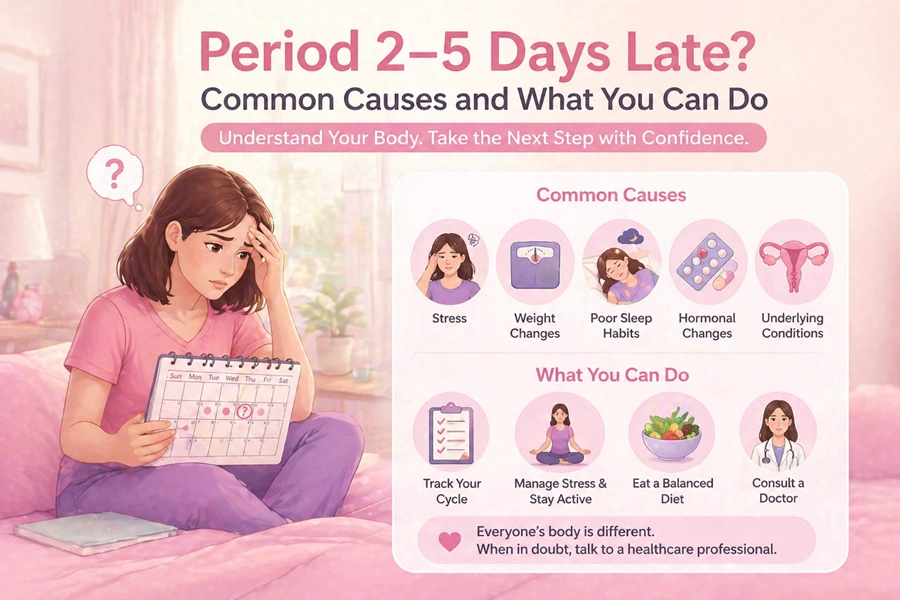
A late period — even a few days — is often caused by stress, routine changes, or small hormonal shifts. These common reasons usually don’t signal an emergency. This guide explains likely causes of a short delay, when to consider a pregnancy test, how to track irregular cycles, and when to contact a clinician so you can decide whether to wait, test, or seek care.
Get SOCIAL with us!
A brief delay is usually not urgent. Stress, sudden lifestyle changes, travel, or minor hormonal fluctuations commonly cause a cycle to be a few days late.
Stress can disrupt the hormonal signals that trigger ovulation. Higher cortisol may delay ovulation so your period comes later. Major shifts in sleep, diet, exercise, or weight can also change timing briefly.
Travel and jet lag can shift your internal clock and delay a period by a few days. Significant diet changes or poor nutrition may also affect hormones. Keeping steady sleep and routines supports more regular cycles.
If pregnancy is possible, waiting to test improves accuracy. Home urine tests detect hCG and are most reliable after a missed period.
For the most reliable result, test at least one week after your missed period to allow hCG to rise. If your cycles are irregular, wait a few extra days or retest to reduce false negatives.
Home pregnancy tests work by detecting the hormone hCG in urine — the sooner hCG reaches a detectable level, the more accurate the test.
How Home Pregnancy Tests Detect hCGHome pregnancy tests use antibodies to pick up human chorionic gonadotropin (hCG), a hormone that increases quickly in early pregnancy and is reliably found in urine. Modern over-the-counter tests measure hCG levels and can give trustworthy results once hCG has risen enough to be detected.Strips of hope: accuracy of home pregnancy testsand new developments, C Gnoth, 2014
Early pregnancy symptoms overlap with other causes and aren’t definitive. A negative home test may mean you tested too early or used it incorrectly. If you still suspect pregnancy, retest in a few days or ask a healthcare provider about a blood test.
Logging your cycle gives context for a late period and helps reveal patterns. Typical cycles range from 21 to 35 days; note dates and symptoms so you can spot unusual delays.
Cycle length varies by person and life stage, commonly 21–35 days. Age, stress, illness, and medications can change length month to month. Keep a simple record—on paper or in an app—to learn your personal baseline over time.
Beyond calendars, researchers are testing physiological signals like basal body temperature and heart rate to improve cycle and fertility predictions, though results vary.
Tracking Cycles with Basal Body Temperature and Heart RateFertility awareness and predicting menses can aid family planning and health management. Studies have explored using basal body temperature (BBT) and heart rate (HR) to predict fertile windows and upcoming periods, but accuracy is not yet perfect—especially for people with irregular cycles. New algorithms aim to improve predictions for both regular and irregular menstruators.Tracking of menstrual cycles and prediction of the fertile window via measurements of basal body temperature and heart rate as well as machine-learning algorithms, 2022
Hormone disruptions—such as PCOS or thyroid problems—can delay or stop ovulation and lead to irregular or missed periods. Repeated delays, new symptoms, or changing bleeding patterns warrant medical evaluation to identify causes and treatment options.
Research shows conditions such as PCOS and thyroid disease can interfere with ovulation and the hormonal balance needed for regular periods.
PCOS and Thyroid Disorders as Causes of Irregular PeriodsPolycystic ovary syndrome (PCOS) is a common hormonal condition characterized by elevated androgens and changes in ovarian appearance and function. Thyroid disorders, including hypothyroidism and autoimmune thyroiditis, are linked to menstrual irregularities and can overlap with features of PCOS. Thyroid dysfunction can contribute to disrupted ovulation and changes in cycle regularity.The impact of polycystic ovary syndrome(PCOS) on the risk of developing ovarian cancer and thyroid disorders: a comprehensive review, S Sanyal, 2024
Short delays are common, but see a clinician for persistent changes or worrying symptoms so you can get appropriate testing and guidance.
See a provider for severe pain, very heavy bleeding, or consistently late periods. Also seek care for new or worsening symptoms, sudden weight changes, or if you’re trying to conceive and have irregular cycles. A clinician can run tests, review medications, and suggest treatments or lifestyle steps.
Her Smart Choice provides confidential reproductive care, pregnancy testing, and consultations in a supportive setting. If you’re worried about a late period, their team can test, explain results, and help plan next steps so you feel supported and clear about your options.
Track your cycle and symptoms, note stressors and medication changes, and try lifestyle adjustments (sleep, nutrition, exercise). If irregular periods persist for months or occur with other symptoms, see a healthcare provider to check for hormonal causes.
Yes. Hormonal contraceptives often change bleeding, and other drugs (some thyroid meds, antidepressants, or steroids) can affect cycles. Don’t stop medicines on your own—discuss options with your clinician.
Reducing stress may help. Try mindfulness, guided breathing, gentle yoga, or daily walks. Prioritize consistent sleep and small habit changes, and seek counseling if stress feels overwhelming.
Aim for a nutrient-rich diet, regular physical activity, and a healthy weight. Cut back on excess caffeine and alcohol and keep a consistent sleep schedule. If changes don’t help, seek medical evaluation.
Some try herbal supplements like chasteberry or evening primrose oil, but evidence varies and interactions are possible. Check with a healthcare provider before starting supplements and prioritize proven lifestyle measures and medical guidance.
Use a calendar, period-tracking app, or written diary to log start and end dates, symptoms, and lifestyle notes. For more precision, some people track basal body temperature, cervical mucus, or use ovulation predictor kits. Share records with a clinician for clearer diagnosis or treatment planning.
A short delay in your period is often explainable and manageable. Track your cycle, review changes in routine or medications, and test thoughtfully if pregnancy is possible. If irregularities persist or symptoms concern you, contact a healthcare provider for personalized evaluation and care. Explore resources or reach out for more support.
Get SOCIAL with us!


.png)
.png)

East LA: 2226 E Cesar E Chavez Ave, Los Angeles, CA 90033, United States
Van Nuys: 7220 Woodman Ave #106, Van Nuys, CA 91405, United States
Long Beach: 1760 Termino Ave #223, Long Beach, CA 90804, United States
Huntington Park: 7024 Seville Ave Suite A, Huntington Park, CA 90255, United States
©2006 – 2025 HER SmartChoice, DBA Cathedral Medical Inc. | Sitemap | Terms & Conditions | Privacy Policy



.svg)
.svg)