

If your period is late after sex, it is understandable to wonder why. A late period does not automatically mean you are pregnant. Pregnancy is one possibility, especially after unprotected vaginal sex or a birth-control mistake, but stress, emergency contraception, hormonal birth control, illness, changes in weight or exercise, and normal menstrual variation can also affect when your period arrives.
If pregnancy is possible, the most useful next step is usually a pregnancy test. Home pregnancy tests work best after your period is late. If your periods are irregular or you are unsure when your period was due, testing about 3 weeks after sex can provide a more reliable result.
Get SOCIAL with us!
If your pregnancy test is positive and the pregnancy is unintended, you have options. In California, abortion remains legal and protected, and eligible patients may be able to access medication abortion through telehealth.
Not directly. Sex itself doesn't delay a period, but pregnancy, emergency contraception, or stress connected to sex can.
Sex itself usually does not make your period late. Instead, something associated with sex may explain the change in your cycle.
For example, pregnancy can cause a missed period. Emergency contraception can temporarily make your period earlier or later. Stress or anxiety surrounding a possible pregnancy can also affect menstrual timing.
Your period can naturally vary from one cycle to another, too. Even if your periods are usually predictable, being a few days early or late does not necessarily mean something is wrong.
If you are sexually active and your period is unexpectedly late, consider whether you had vaginal sex, whether a condom was used correctly, whether semen may have entered the vagina, whether you missed or incorrectly took birth-control pills, whether you used emergency contraception, when the sex occurred, how many days your period is late, and whether you have taken a pregnancy test.
These details can help you decide whether you should test for pregnancy or consider another explanation. Our guide on birth control methods, types, effectiveness, safety, and side effects can help you think through what "used correctly" means for your specific method.
Several factors can be at play, and pregnancy is only one of them, alongside stress, emergency contraception, hormonal birth control, illness, weight changes, and normal cycle variation.
Several factors can cause a late period after sex.
Pregnancy is one of the most important possibilities to consider if you had unprotected vaginal sex or your birth control may have failed.
A missed period can be an early pregnancy sign, but a late period alone cannot confirm pregnancy. The only way to know is to take a pregnancy test.
Pregnancy tests detect human chorionic gonadotropin (hCG), a hormone produced during pregnancy. Testing too early can result in a false-negative result because there may not yet be enough hCG for the test to detect.
For the most reliable result, test after your missed period. If you have irregular periods or do not know when your period was expected, Planned Parenthood recommends testing about 3 weeks after sex, since it can take up to six days after sex for fertilization to occur and additional time for the fertilized egg to implant and start producing detectable hCG.
Stress can affect the hormones involved in your menstrual cycle.
If you have been anxious about pregnancy, dealing with school or work pressure, sleeping poorly, or experiencing a major life change, your period may arrive later than expected.
However, if you had sex that could result in pregnancy, do not assume stress is the reason your period is late. Take a pregnancy test when appropriate.
Emergency contraception can change your next period.
After taking an emergency contraceptive pill such as Plan B or ella, your period may come earlier or later than usual. You may also notice spotting or changes in the amount of bleeding.
If you do not get your period within 3 weeks after taking emergency contraception, take a pregnancy test.
If you recently had unprotected sex, read our guide on when to take Plan B to learn more about emergency contraception timing, and can Plan B make your period late for more on this specific pattern.
Birth-control methods can change your menstrual pattern.
The pill, hormonal IUD, implant, vaginal ring, patch, and Depo shot can make periods lighter, irregular, less frequent, or stop altogether for some people.
A missed or changed period while using hormonal birth control does not automatically mean pregnancy.
If you are considering contraception or want to compare different options, our guide to birth control methods, types, effectiveness, safety, and side effects can help, and is it harmful to skip your period on birth control addresses a related concern for anyone on a method that intentionally reduces periods.
Significant changes in weight, intense exercise, restrictive eating, or inadequate nutrition can affect your menstrual cycle.
Your reproductive hormones are sensitive to changes in your body's energy balance, so a late period can sometimes occur even when pregnancy is not involved.
Being sick or experiencing other hormonal changes can temporarily affect your cycle.
If your periods are repeatedly late, unusually irregular, or absent for a prolonged period, talk with a healthcare professional to determine whether another underlying issue could be contributing.
Your period does not necessarily arrive on exactly the same day every month.
A cycle that is a few days longer than usual does not automatically mean pregnancy. This is particularly important for teenagers and people who naturally have irregular cycles.
There's no magic number of days that confirms pregnancy or rules it out. Timing your test matters more than counting days late.
There is no specific number of days that means a period is definitely abnormal.
A period that is one or two days late may simply reflect normal cycle variation. But if pregnancy is possible, the number of days late is less important than when you take the pregnancy test.
The key point is that you do not need to wait an arbitrary number of days before testing if your period is already late. Pregnancy tests work best after a missed period. Our guides on is your period 4 days late and 17 days period late walk through what's typical at each stage.
If your period is already late, test now. If you're not sure when it was due, 3 weeks after the sex in question is a reliable benchmark.
If your period is late, you can take a pregnancy test now.
Home pregnancy tests are most reliable after your missed period. Some tests claim to detect pregnancy before a missed period, but testing earlier can increase the chance of an inaccurate result.
If you do not know when your period was due because your cycles are irregular, wait until about 3 weeks after sex before relying on the result.
If sex happened less than a week ago, it may be too early for a pregnancy test to reliably detect pregnancy. If sex happened about 2 weeks ago, testing may provide useful information, but depending on your cycle and timing, you may need to repeat the test. If sex happened 3 weeks ago or longer, a pregnancy test should provide a more reliable answer.
If you are unsure about testing timing, see our guide on how soon after unprotected sex you can reliably take a pregnancy test and pregnancy tests at two weeks: when to test.
A negative test is reassuring, but the timing of when you took it matters. Testing too early is the most common reason for a misleading result.
A negative pregnancy test is reassuring, but timing matters.
If you tested very early, your body may not have produced enough hCG for the test to detect pregnancy. A false-negative result is possible.
If your period remains absent, check how long it has been since the sex that could have caused pregnancy, consider whether you tested before your period was due, repeat the pregnancy test if you may have tested too early, consider other causes such as stress, illness, hormonal birth control, or changes in weight or exercise, and contact a healthcare professional if your period continues to be absent or your cycles repeatedly become irregular.
Planned Parenthood notes that a negative test after a missed period makes pregnancy less likely, although repeating the test can be appropriate if pregnancy remains a concern.
For more information, read when to worry after missing a period.
Emergency contraception may still be an option, and it works better the sooner it's used, so don't wait for a late period to consider it.
If you had unprotected vaginal sex within the past 5 days (120 hours) and do not want to become pregnant, emergency contraception may still be an option. It generally works better the sooner it is used.
Emergency contraception prevents pregnancy; it does not end an existing pregnancy.
Depending on the circumstances, emergency contraception options may include emergency contraceptive pills or an IUD. Our guides on when to take Plan B and how much emergency contraception costs can help you weigh these options.
If you are still within the appropriate time window, do not wait for your period to become late before considering emergency contraception.
Yes, and it's a well-documented effect, not a sign that something went wrong.
Yes. Plan B and other emergency contraceptive pills can make your next period earlier or later than expected.
You may also experience spotting, lighter bleeding, heavier bleeding, a period that comes earlier, or a period that comes later.
These changes can be temporary.
If you do not get your period within 3 weeks after taking emergency contraception, take a pregnancy test.
If you frequently need emergency contraception, consider discussing a regular birth-control method with a healthcare professional. Options include pills, implants, IUDs, patches, rings, and injections. Our full guide on can Plan B make your period late covers this pattern in much more depth.
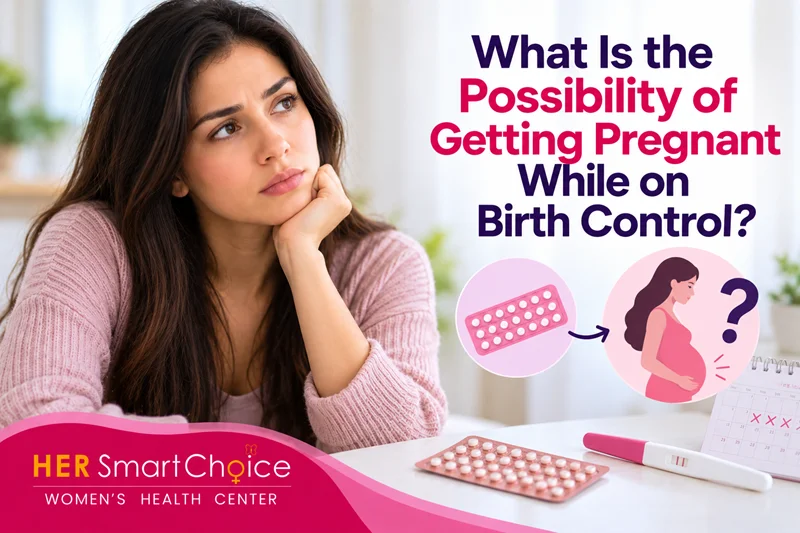
Yes, since no method is 100% effective, though your actual risk depends heavily on the method and how consistently it was used.
Yes, although your risk depends on the method and how consistently it was used.
For example, pregnancy may be possible if a condom broke or slipped, a condom was not used for the entire sexual encounter, birth-control pills were missed, a contraceptive method was used incorrectly, you were late receiving a birth-control shot, you started a method without allowing enough time for it to become effective, or you had sex after stopping contraception.
No contraceptive method is completely effective.
If you are worried that your birth control failed and your period is late, taking a pregnancy test can give you a clearer answer than trying to interpret symptoms. Our guides on can I get pregnant if I forget one birth control pill and evaluating birth control effectiveness and pregnancy risks can help you gauge your specific situation, and can you get pregnant on the birth control Depo shot addresses that method specifically.
Whatever you feel is valid, and you have real options: continuing the pregnancy, adoption, or abortion.
If your pregnancy test is positive, you may feel excited, scared, uncertain, or a combination of emotions. There is no single "correct" way to feel.
Your options generally include continuing the pregnancy and parenting, adoption, or abortion.
If you are considering abortion, you can speak with a qualified healthcare provider about your options, pregnancy timing, and which type of abortion care may be appropriate, as covered in is medication abortion right for me.
Medication abortion, commonly called the abortion pill, uses medications to end an early pregnancy, as explained in what is a medication abortion and how the abortion pill works.
The California Department of Public Health states that medication abortion remains available and protected in California. Depending on eligibility and the provider, medication may be available by mail following a telehealth visit with a qualified provider, as covered in telehealth abortion safety and privacy.
Her Smart Choice offers confidential abortion-care information and can help eligible patients explore whether telehealth abortion care may be appropriate. See abortion pill: what to expect and how much the abortion pill costs in Los Angeles for more on what that process involves.
You do not have to make an abortion decision simply because your period is late. First, confirm whether you are pregnant and then discuss your options.
Yes. California protects abortion access, including medication abortion by telehealth for eligible patients.
Yes. Abortion is legal and protected in California.
The California Department of Public Health states that abortion, including medication abortion, remains available and protected in the state. California also provides access to telehealth options for eligible patients seeking medication abortion, as explained in how telehealth abortion works in California for out-of-state patients.
California's official abortion resources also provide information about finding providers, telehealth options, financial assistance, and patient rights, as covered in the importance of confidentiality in abortion care and how late you can have an abortion in California.
If you are in California and have received a positive pregnancy test, a confidential telehealth consultation may be a convenient way to discuss your pregnancy and abortion-care options without immediately traveling to a clinic. See abortion care in Los Angeles and first abortion clinic visit in Huntington Park for local options.
A single late period usually isn't urgent, but recurring irregularity, ongoing pain, or persistent negative tests despite a missing period deserve a visit.
A single late period is usually not an emergency.
However, consider talking with a healthcare professional if you repeatedly miss periods, your menstrual cycles suddenly become very irregular, your period remains absent despite negative pregnancy tests, you have unusual or persistent bleeding, you have ongoing pelvic pain, you are concerned about pregnancy or contraception, or you have other symptoms that concern you. Our guide on abnormal vaginal bleeding covers a related set of warning signs.
If you have a positive pregnancy test along with severe abdominal or pelvic pain, fainting, significant dizziness, or heavy bleeding, seek urgent medical evaluation.
These symptoms can sometimes indicate a pregnancy complication that requires prompt assessment.
A reliable ongoing method, matched to your lifestyle, takes the guesswork out of every late period going forward.
If you do not want to become pregnant, choosing a reliable birth-control method can reduce the stress associated with a late period.
Depending on your preferences, options include birth-control pills, condoms, vaginal rings, birth-control patches, birth-control implants, hormonal IUDs, copper IUDs, Depo-Provera injections, and emergency contraception.
Condoms can also help reduce the risk of sexually transmitted infections (STIs), while most hormonal birth-control methods do not protect against STIs.
The best method depends on your health, preferences, lifestyle, side-effect concerns, desired pregnancy timing, and how often you want to think about contraception.
Read our birth control methods guide to compare different options, and our guide to birth control options in Los Angeles and what to ask before booking a birth control appointment can help you take the next step.
Sex itself usually does not make your period late. Pregnancy, stress, emergency contraception, hormonal birth control, illness, changes in weight or exercise, and normal cycle variation can affect menstrual timing.
Yes, pregnancy is possible if you had sex that could result in pregnancy. However, being two days late does not prove that you are pregnant. Take a pregnancy test if pregnancy is possible.
You can take a pregnancy test once your period is late. If you have irregular periods or do not know when your period was due, testing about 3 weeks after sex can provide a more reliable result.
Yes. Significant stress can affect your menstrual cycle. However, if pregnancy is possible, take a pregnancy test rather than assuming stress is the cause.
Yes. Emergency contraceptive pills such as Plan B can cause your next period to arrive earlier or later than usual. If you do not get your period within 3 weeks after taking emergency contraception, take a pregnancy test.
If you are 17 days late, consider when you last had sex that could have caused pregnancy and when you took the test. If you tested too early, repeat the test. If pregnancy tests remain negative and your period does not return, consider talking with a healthcare professional. Our guide on 17 days period late covers this exact scenario.
Yes, particularly if you tested too early. Pregnancy tests are most reliable after a missed period, and testing about 3 weeks after sex is recommended when periods are irregular or the expected period date is unknown.
Eligible patients may be able to receive medication abortion through telehealth in California. The California Department of Public Health confirms that medication abortion remains available and that some providers offer medication by mail following a telehealth visit.
A late period alone is generally not an emergency. Take a pregnancy test if pregnancy is possible. Seek urgent medical care if you have severe pelvic or abdominal pain, fainting, significant dizziness, or heavy bleeding, particularly if you have a positive pregnancy test.
There are several possible explanations for why your period is late after sex.
Pregnancy is one possibility, particularly after unprotected vaginal sex or a birth-control failure. But stress, emergency contraception, hormonal birth control, illness, changes in weight or exercise, and normal cycle variation can also delay your period.
If pregnancy is possible, take a pregnancy test after your missed period. If your periods are irregular or you do not know when your period was due, testing about 3 weeks after sex is a useful guideline.
If your test is positive and the pregnancy is unintended, you have options. In California, abortion remains legal and protected, and eligible patients may be able to access medication abortion through telehealth.
If you are considering abortion, Her Smart Choice can help you understand your options and determine whether a confidential telehealth consultation may be appropriate for you.
Get SOCIAL with us!


.png)
.png)

East LA: 2226 E Cesar E Chavez Ave, Los Angeles, CA 90033, United States
Van Nuys: 7220 Woodman Ave #106, Van Nuys, CA 91405, United States
Long Beach: 1760 Termino Ave #223, Long Beach, CA 90804, United States
Huntington Park: 7024 Seville Ave Suite A, Huntington Park, CA 90255, United States
©2006 – 2026 HER SmartChoice, DBA Cathedral Medical Inc. | Sitemap | Terms & Conditions | Privacy Policy




.svg)
.svg)